Methodology
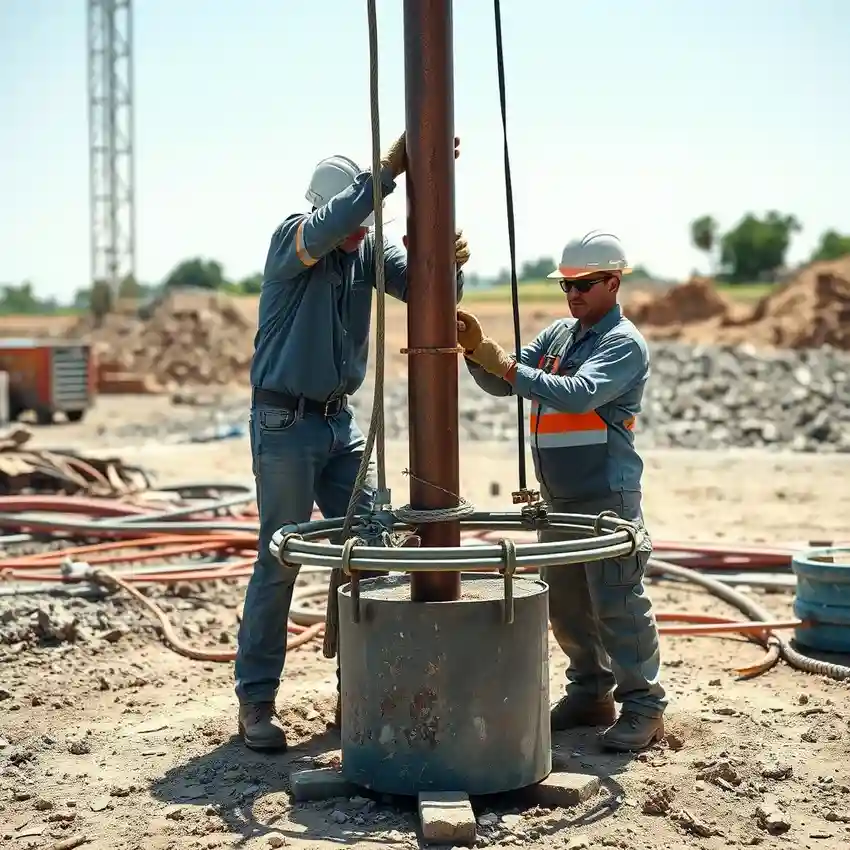
Our approach in Baltimore begins with a thorough understanding of the site-specific subsurface conditions. We assess the sequence of sands, clays, and gravels typical of the Coastal Plain to identify target aquifers, such as the Patapsco or Aquia formations. This initial assessment guides our water well drilling strategy, selecting appropriate techniques—whether rotary, cable tool, or sonic—to efficiently penetrate the overburden and reach the water-bearing strata. We meticulously log all cuttings, install casing and screen to prevent aquifer contamination, and develop the well to optimize yield and water clarity.
Reference Technical Parameters
| Parameter | Reference Value |
|---|---|
| Predominant Soil Type | Heterogeneous sequence of sands, silts, and clays (Coastal Plain sediments) |
| Typical Bedrock Depth | 200 to 1000 feet below surface (crystalline basement) |
| Typical Groundwater Level | 10 to 50 feet BGS |
| Maximum Seismic Acceleration (PGA) | Low to Moderate (Site-Specific Evaluation Recommended) |
| Typical Target Aquifer | Patapsco Formation / Upper Cretaceous Sands |
Local Considerations — Baltimore
1. **Geology & Aquifers**: The primary challenge is the heterogeneity of sediments; successful drilling requires identifying discontinuous sand layers within thick clay sequences. 2. **Water Table Depth**: Typically ranges from 10 to 50 feet below ground surface, but can be deeper in elevated areas or during drought. 3. **Seismic Activity**: While not a primary design driver like on the West Coast, local faulting is considered in well casing design for long-term integrity. 4. **Urban vs. Rural Contrast**: In the city and inner suburbs, well placement must carefully avoid legacy underground infrastructure, whereas in surrounding counties like Baltimore or Harford, agricultural contamination is a greater concern. 5. **Typical Projects**: Many successful projects involve tapping the Patapsco aquifer for residential or light commercial use, often requiring a detailed hydrogeological survey prior to drilling to confirm viability.
Request a Quote
Our team reviews your project and issues an initial report at no cost.
Or write us directly at [email protected]
Services in Baltimore
Applicable Standards
- Maryland Department of the Environment (MDE) Well Construction Code
- Code of Maryland Regulations (COMAR) 26.04.04
- Local County Health Department Permits
Frequently Asked Questions
What are the main soil and geological challenges for drilling a water well in Baltimore?
The primary challenge is the highly variable and layered geology of the Atlantic Coastal Plain. Drillers may encounter alternating sequences of loose sand, dense clay, and gravel without clear continuity. This requires real-time interpretation of drill cuttings and potentially adjusting methods mid-operation to efficiently reach a productive aquifer without well collapse or sand intrusion.
Are there specific seismic design considerations for wells in this region?
While seismic risk is lower than in active tectonic zones, the Baltimore area is not without fault lines and historical seismic events. Our well design considers ground shaking potential for critical infrastructure projects, ensuring casing and grout integrity can withstand low-probability seismic events as part of a resilient water supply system.
Is a hydrogeological study mandatory before drilling a well in Baltimore?
While not always mandated by code for single-family residential wells on large lots, a professional hydrogeological survey is highly recommended and often required by local counties for commercial or agricultural wells. It is essential for determining probable yield, avoiding contaminated zones, and ensuring the sustainable use of the aquifer, which aligns with MDE's resource management goals.